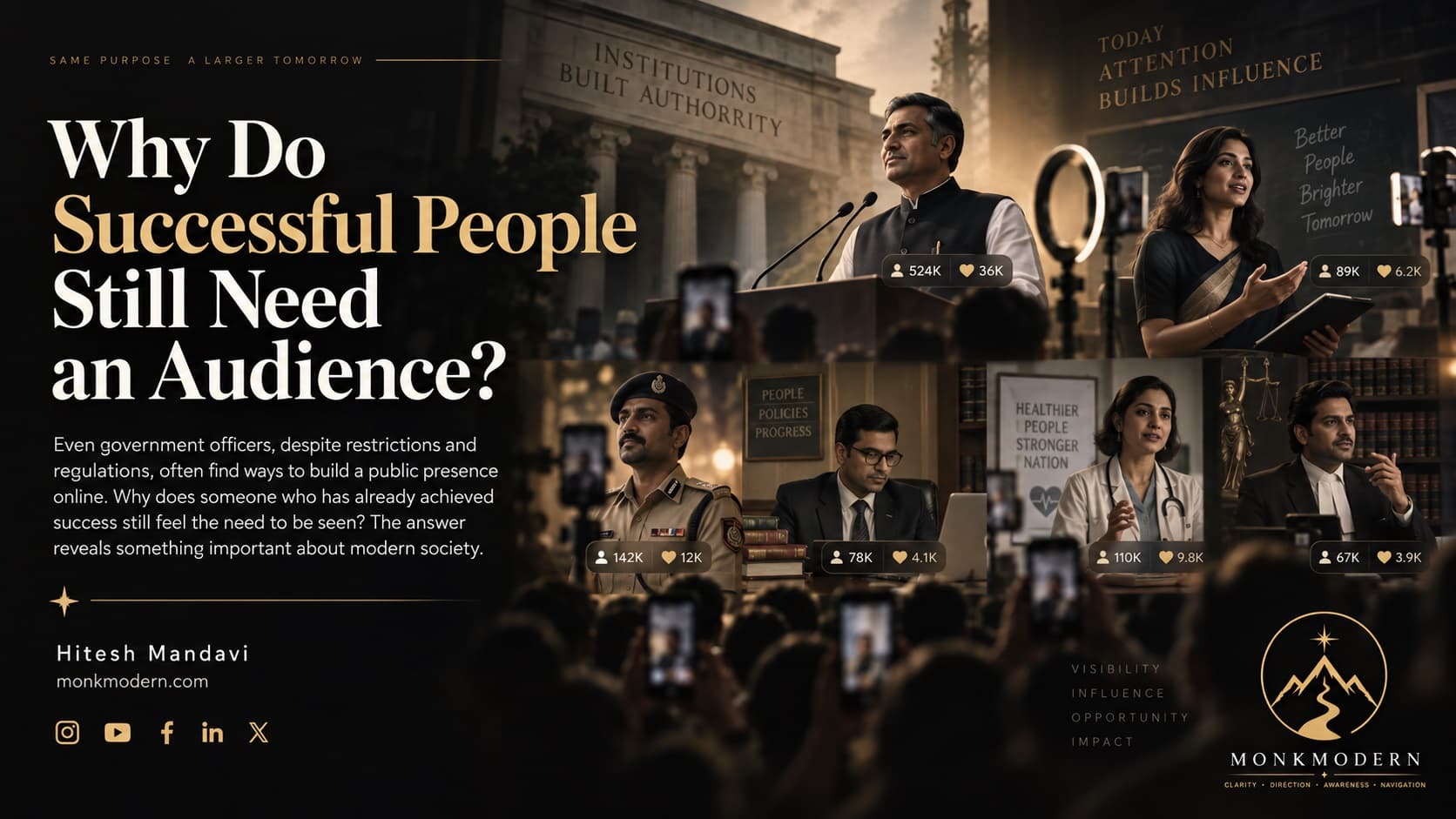
Why Do Successful People Still Need an Audience?
Even government officers, despite restrictions and regulations, often find ways to build a public presence online. Why does someone who has already achieved success still feel the need to be seen? The answer reveals something important about modern society.
Archive Note: This reflection was first published on the earlier WordPress version of MonkModern on June 19, 2026. It is republished here as part of the MonkModern memoir archive.
The Hidden Search for Identity in the Age of Content
A few years ago, becoming a doctor was enough.
Becoming a government officer was enough.
Becoming a professor was enough.
Becoming a successful business owner was enough.
The title itself carried recognition, respect, and social status.
But something interesting has changed.
Today, many doctors create content.
Many nurses create content.
Many lawyers create content.
Many teachers create content.
Many entrepreneurs create content.
Even government officers, despite restrictions and regulations, often find ways to build a public presence online.
At first, I thought this was simply a trend.
Then I started asking a deeper question:
Why does someone who has already achieved success still feel the need to be seen?
The answer reveals something important about modern society.
The Achievement That Doesn't Feel Complete
Imagine someone spends years preparing for a competitive examination.
They sacrifice comfort.
They sacrifice social life.
They sacrifice time.
Eventually they achieve the position they dreamed about.
For years they believed:
"Once I reach there, I will feel complete."
But human psychology doesn't work that way.
The moment one mountain is climbed, another appears.
The mind quickly adapts.
What once felt extraordinary slowly becomes normal.
Psychologists call this adaptation.
Ancient spiritual traditions called it desire.
The result is the same.
Achievement creates satisfaction.
But usually only for a while.
Then a new search begins.
The Shift from Status to Significance
In the past, status came from institutions.
Today, status increasingly comes from attention.
A person may have a respected profession.
Yet they still want an audience.
Why?
Because attention has become a new form of social currency.
People no longer want only success.
They want visibility.
They want influence.
They want to be known.
The question is no longer:
"What do you do?"
The question has become:
"How many people know what you do?"
This subtle shift has changed society more than most people realize.
The Fear of Being Invisible
I don't think most people start creating content because of money.
Some do.
But many don't.
Many are searching for something deeper.
Recognition.
Significance.
Expression.
Connection.
Or perhaps protection against a hidden fear:
The fear of being invisible.
Social media has created a strange psychological environment.
Millions of people are constantly displaying their achievements.
Their travels.
Their lifestyles.
Their opinions.
Their expertise.
Their victories.
As a result, ordinary life often starts feeling insufficient.
People begin comparing their private reality to everyone else's public highlight reel.
A successful professional may suddenly feel unnoticed.
Not because they lack achievement.
But because someone else appears to have more visibility.
When Success Is No Longer Enough
This is one of the most fascinating shifts of our time.
There was a period when professional excellence was enough.
Now many people feel they need a second identity.
A doctor becomes a creator.
A teacher becomes an influencer.
An entrepreneur becomes a personal brand.
A professional becomes a public figure.
There is nothing inherently wrong with this.
In many cases it creates opportunities, education, and impact.
The problem begins when visibility becomes a substitute for self-worth.
When likes become emotional validation.
When followers become a measure of value.
When attention becomes a requirement for happiness.
At that point the search is no longer external.
It becomes psychological.
The Difference Between Expression and Validation
This distinction is important.
There is a healthy reason to create.
And there is an unhealthy reason to create.
Healthy creation says:
"I have something valuable to share."
Unhealthy creation says:
"I need proof that I matter."
One creates from abundance.
The other creates from deficiency.
From the outside both activities look identical.
Both upload videos.
Both write posts.
Both build audiences.
But internally they are completely different experiences.
One brings freedom.
The other creates dependency.
The Most Powerful Form of Freedom
Recently I came across a sentence that stayed with me:
"The person who is genuinely content alone has handed no one the keys to their happiness."
The more I think about it, the more revolutionary it seems.
A person who can sit quietly with themselves without needing constant validation possesses a rare kind of freedom.
This does not mean avoiding success.
It does not mean rejecting ambition.
It does not mean abandoning creation.
It simply means not depending on external recognition to feel complete.
Such a person may still build a business.
They may still create content.
They may still lead organizations.
But their happiness remains internal.
Not outsourced.
Not rented from public opinion.
Not dependent on applause.
The Question We Should All Ask
The issue is not whether we should create content.
The issue is why we are creating it.
Are we sharing because we have something meaningful to contribute?
Or are we trying to fill an inner emptiness?
Are we expressing ourselves?
Or are we searching for validation?
These questions matter because they determine whether our work becomes a source of freedom or a source of psychological dependence.
Perhaps the greatest challenge of the digital age is not learning how to get attention.
Perhaps it is learning how to remain whole without it.
Because a person who can create, contribute, and participate in the world while remaining content within themselves possesses something far more valuable than followers.
They possess freedom.
-Hitesh Mandavi
Reader Reflection
What part of this reflection stayed with you?
What insight, question, or experience did it bring up?
Share this article
Related Resource
Life Navigation Framework
Tools and mental models for understanding direction, timing, patterns, and life decisions.