I Stopped Waiting for the Right Time — And Started Choosing for Myself
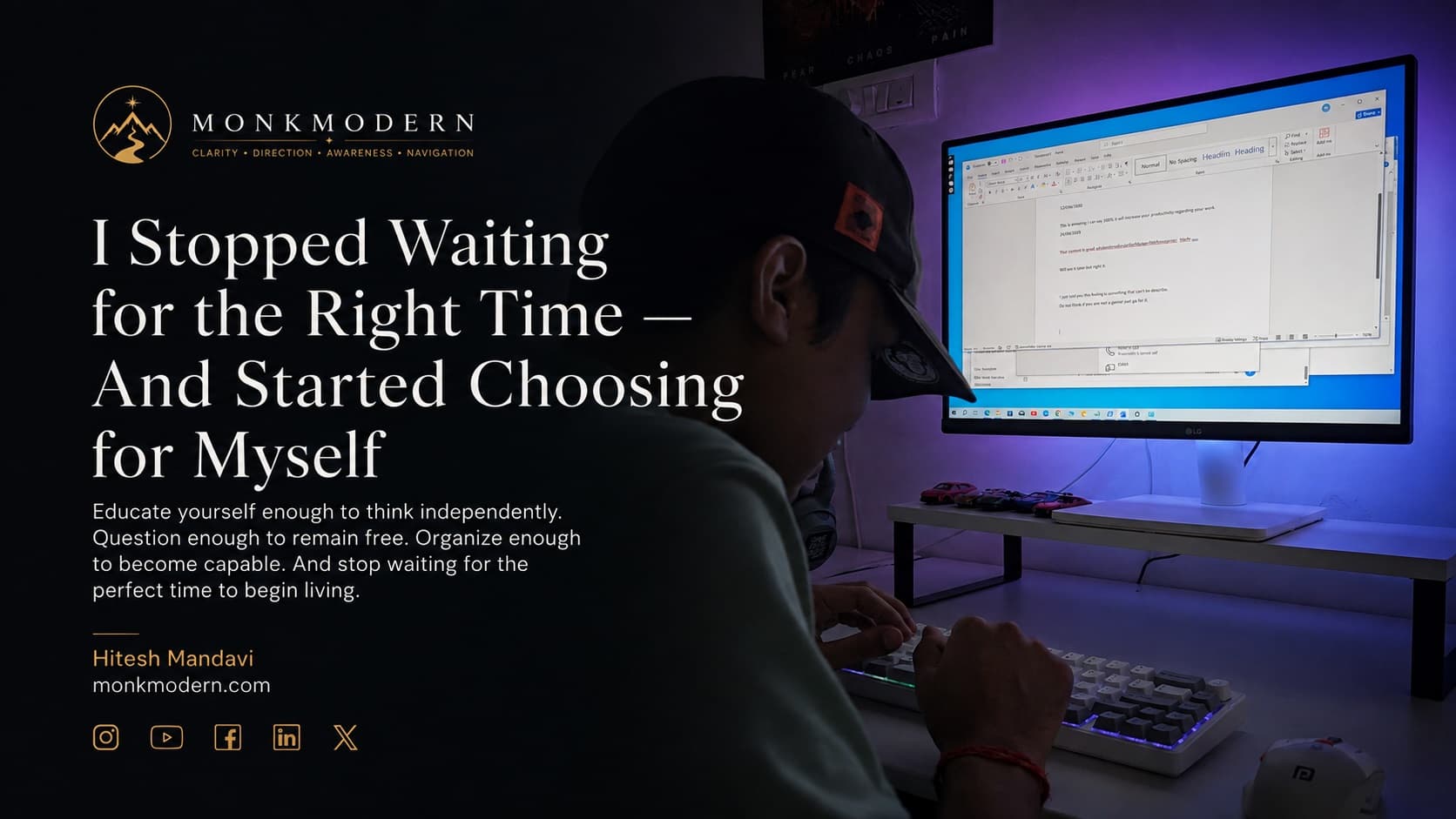
Educate yourself enough to think independently. Question enough to remain free. Organize enough to become capable. And stop waiting for the perfect time to begin living.
I Stopped Waiting for the Right Time — And Started Choosing for Myself
September is here.
More than half of the year is already gone.
Normally, this would be the point where I would look back at the year—what I accomplished, what I wasted, what I still need to do.
But today, I don't want to talk about the year.
I want to talk about something I have realized recently.
Something that started with something as ordinary as a keyboard.
The Keyboard That Made Me Question My Waiting
I am writing this on my brand-new mechanical keyboard.
And strangely, the experience has affected me much more than I expected.
For years, I had been using my old keyboard. I knew it wasn't comfortable. I knew typing required unnecessary effort. I knew there were things about it that irritated me.
But I kept using it.
Somewhere inside my mind was the thought:
I will upgrade later.
When I have more money.
When it feels financially appropriate.
When the timing is right.
When I can justify spending on something better.
Then I finally bought the new one.
And within minutes of using it, I had only one thought:
Why didn't I do this earlier?
The difference wasn't small.
Typing suddenly felt effortless.
Smooth.
Enjoyable.
Something I had tolerated for years wasn't actually something I needed to tolerate.
And that made me realize something bigger.
There is a difference between being financially irresponsible and endlessly postponing your life.
If I can afford something today, if it genuinely improves my life, and if buying it doesn't create a financial problem afterward, then why should I keep waiting for some imaginary future version of myself to experience it?
That question stayed with me.
And suddenly, it wasn't about a keyboard anymore.
How Much of Life Are We Postponing?
How many things do we keep pushing into the future?
I will start creating content when everything is ready.
I will take my profession seriously when I reach a certain stage.
I will start writing when I feel inspired.
I will build something when I have more resources.
I will travel when I have more money.
I will improve my lifestyle later.
I will become disciplined from Monday.
I will begin when the timing feels perfect.
But what if the timing we are waiting for doesn't exist?
What if many of the things we want can already begin with what we currently have?
This doesn't mean spending recklessly.
It doesn't mean becoming impatient.
It doesn't mean doing everything immediately.
It simply means asking a more honest question:
Is there actually a reason to wait, or am I just emotionally postponing something?
I have made statements like this before.
I have told myself many times that I will start.
That I will stop delaying things.
That I will become more consistent.
So I understand why another declaration alone means nothing.
But something feels different this time.
Recently, I figured out how to handle one of the biggest problems that repeatedly ruined my days.
It was something I had wanted to escape for a long time.
And after a long gap, I started writing again.
Maybe that is why this realization feels less like motivation and more like evidence.
Something has actually shifted.
Then Another Kind of Clarity Arrived
At the same time, something else has been happening in my mind.
Something more complicated.
For the last few days, I have been observing political and social discussions much more seriously.
For a long time, I tried to stay away from choosing sides.
I thought perhaps it was better to remain detached.
To observe everyone.
To avoid getting pulled into ideology.
But I have started realizing that there are moments in life when complete neutrality becomes impossible.
At some point, you have to decide what you believe.
What you support.
What you oppose.
What you are willing to stand for.
But there is an important distinction I understand much better now:
Choosing a side does not mean surrendering your mind to that side.
That distinction may be one of the most important things I have learned.
Intellectual People Can Also Become Ideological
There were certain people I once listened to because I considered them intellectual.
They sounded logical.
They questioned society.
They challenged commonly accepted beliefs.
They appeared rational and independent.
And slowly, I started taking many of their arguments seriously.
Not everything.
There were always certain questions in my mind.
Certain things that didn't completely make sense to me.
But sometimes when someone sounds intelligent enough, we begin assuming that their conclusions must also be intelligent.
Eventually, I started noticing something.
Some people who constantly speak about rationality are rational only until you question their own beliefs.
They support questioning institutions.
They support questioning traditions.
They support questioning religion.
They support questioning governments.
But question their ideological position and suddenly questioning itself becomes unacceptable.
The person who disagrees becomes stupid.
An enemy.
Brainwashed.
Immoral.
Dangerous.
And that contradiction taught me something.
Someone can sound intellectual without actually practicing intellectual freedom.
Real intellectual honesty means being willing to question your own side too.
Not just your opponent.
Changing Masters Is Not Freedom
I don't want to become mentally dependent on anybody's worldview.
Because if I reject one ideology only to unquestioningly adopt another, nothing fundamental has changed.
The master changed.
The obedience remained.
That is not freedom.
Real freedom requires something more difficult:
To listen without surrendering.
To learn without worshipping.
To agree without becoming blind.
To disagree without becoming hateful.
To remain capable of saying:
"I supported this person on one issue, but I believe they are wrong on this one."
That sounds simple.
In reality, it is extremely difficult.
Human beings want belonging.
We want tribes.
We want people who confirm what we already believe.
And once we emotionally identify with a group, criticism of the group begins to feel like criticism of ourselves.
That is when thinking becomes dangerous.
Because now we are no longer searching for truth.
We are defending identity.
Give Yourself Permission to Hear Everyone
When I look back at my own journey, one thing protected me.
Curiosity.
I gave myself permission to hear different people.
Sometimes people I disagreed with.
Sometimes people I disliked.
Sometimes people whose ideology I initially rejected.
I was searching for truth without even realizing that I was searching for it.
And because I continued asking questions, some of the beliefs I had started accepting eventually began collapsing.
Recent events forced me to confront certain contradictions more directly.
Things that I previously ignored became difficult to ignore.
People exposed their priorities.
Their biases became visible.
Their supposed objectivity became selective.
And I realized something uncomfortable:
Everyone has interests.
Political groups have interests.
Institutions have interests.
Communities have interests.
Influencers have interests.
Intellectuals have interests.
Even people who claim neutrality may have interests.
Understanding this doesn't mean becoming paranoid.
It means becoming aware.
Don't Expect Everyone to Stand With You
Another realization came with it.
You cannot build your life on the assumption that people will always stand for you simply because you are right.
People may support justice in theory.
But when their own interests, relationships, identity, reputation, money or political loyalty become involved, things can change very quickly.
This doesn't mean nobody is trustworthy.
It doesn't mean society is entirely selfish.
And it definitely doesn't mean we should stop building relationships or communities.
But it does mean something important:
You need the ability to stand on your own feet.
Your family may stand with you.
Friends may stand with you.
A community may stand with you.
Sometimes even strangers will.
But your survival cannot depend entirely upon somebody else's courage.
You need education.
You need awareness.
You need competence.
You need rights.
You need economic independence.
You need people.
And you need the ability to think.
Which brings me to three words that suddenly mean much more to me now.
Educate. Agitate. Organize.
Dr. B. R. Ambedkar gave one of the most powerful instructions for social empowerment:
Educate. Agitate. Organize.
The order matters.
Educate
Education comes first.
Before anger.
Before rebellion.
Before ideology.
Before choosing sides.
Understand.
Read history.
Understand law.
Understand economics.
Understand social structures.
Understand power.
Listen to people you agree with.
But perhaps more importantly, listen seriously to intelligent people you disagree with.
Education gives you something extremely valuable:
The ability to recognize when somebody is manipulating your ignorance.
Agitate
Once you understand something, there are moments when silence is no longer enough.
Ask questions.
Challenge ideas.
Challenge unfairness.
Refuse to accept something simply because society has normalized it.
But agitation should not mean blind rage.
Anger without understanding can easily be manipulated.
Agitation guided by education is different.
It comes from awareness.
Organize
And finally, organize.
Because individual understanding without structure rarely changes much.
People need communities.
Institutions.
Networks.
Systems.
Platforms.
Organizations.
Economic strength.
Social cooperation.
You cannot build everything alone.
Individual awakening may begin change.
Organization gives it durability.
Maybe This Is the Real Lesson
It is strange how all these realizations came together for me at the same time.
I painted my room myself.
I rebuilt my workspace.
I finally created the setup I had imagined for years.
I upgraded things I had unnecessarily tolerated.
I started writing again.
And at the same time, I started questioning some of the intellectual influences I had allowed into my mind.
Maybe these are not separate things.
Maybe they are different versions of the same lesson.
Stop waiting for permission.
Stop waiting for perfect conditions.
Stop assuming someone else knows better simply because they speak confidently.
Stop postponing things that are already within your reach.
Improve what you can improve.
Learn what you don't understand.
Question what you are told.
Choose your stand consciously.
Remain willing to change your mind when evidence demands it.
And then act.
I don't know what the remaining months of this year will bring.
But I don't want September to become another symbolic "new beginning."
I have had enough new beginnings.
What I want now is continuation.
Execution.
Work.
Learning.
Writing.
Building.
And perhaps the principle I want to carry forward is simpler than everything I have written here:
Educate yourself enough to think independently.
Question enough to remain free.
Organize enough to become capable.
And stop waiting for the perfect time to begin living.
Reader Reflection
What part of this reflection stayed with you?
What insight, question, or experience did it bring up?
Share this article
Related Resource
Do Nothing
A practical exploration of stillness, attention, and clarity in a world addicted to constant movement.