What Building MonkModern Taught Me About Clarity
A reflection on how building MonkModern revealed that clarity is not something we always find before action, but something that often emerges through the act of building.
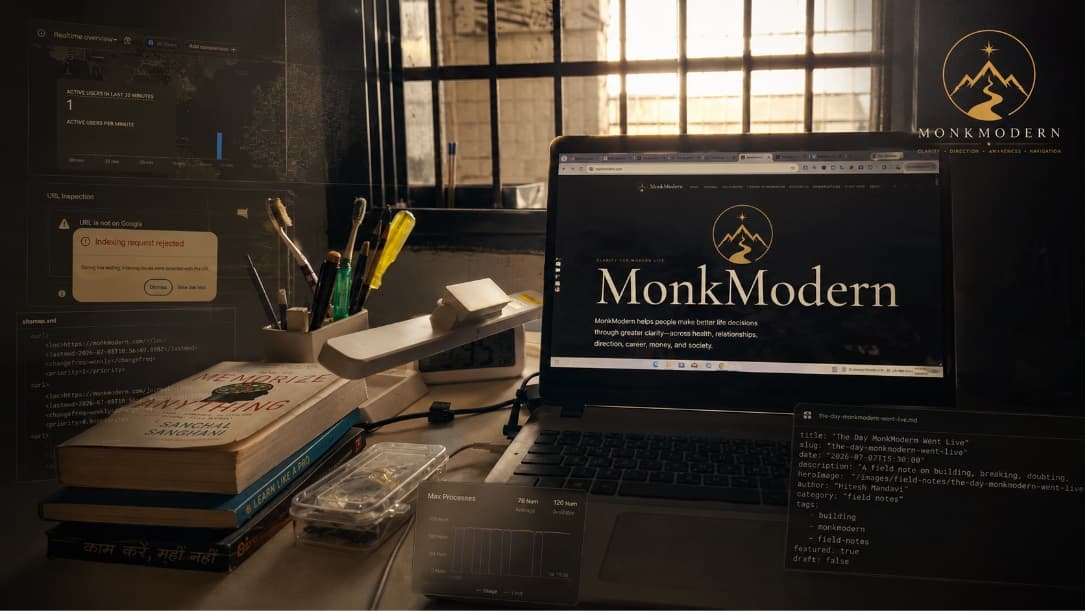
There is a strange thing that happens when you build something from the inside.
At first, you think you are building a website.
Then slowly, quietly, almost without warning, you realize the website is also building you.
That is what happened with MonkModern.
When I started working on the website, I thought the main challenge would be design. The homepage, the logo, the sections, the articles, the images, the mobile view, the navigation, the publishing system — all of these looked like separate technical tasks.
But as the process unfolded, I realized the real challenge was not only technical.
It was clarity.
Not the kind of clarity that appears before action.
The kind of clarity that appears because of action.
Clarity does not always come before building
For a long time, I used to believe that before starting something meaningful, I needed to fully understand it.
I needed the perfect structure.
The perfect category.
The perfect positioning.
The perfect language.
The perfect system.
But building MonkModern slowly challenged that belief.
Because I did not fully understand MonkModern before building it.
I understood it while building it.
Every time I created a page, something became clearer.
Every time something broke, something became more real.
Every time I got confused, I was forced to ask a better question.
What is this website actually for?
Is MonkModern a blog?
Is it a personal brand?
Is it a consultation platform?
Is it a journal?
Is it a life-navigation framework?
Is it a future product ecosystem?
At first, the answer kept changing. That felt uncomfortable.
But now I understand that the changing answer was not confusion.
It was evolution.
The website exposed the hidden questions
A website looks like a design project from the outside.
But from the inside, it becomes a mirror.
Every section asked me a question.
The homepage asked:
What is MonkModern in one sentence?
The About page asked:
Who am I becoming through this work?
The Start Here page asked:
Where should someone begin if they are new to this world?
The Journal asked:
What kind of thinking do I want to share?
The Resources page asked:
What can I give people beyond words?
The Consultation page asked:
What kind of problems am I actually willing to help people solve?
These questions were not just website questions.
They were identity questions.
That is why the process felt heavy sometimes. I was not simply arranging content on a screen. I was trying to arrange years of thought, experience, confusion, silence, study, observation, and personal transformation into a structure someone else could understand.
That is not easy.
Building reveals what thinking hides
Thinking can create beautiful possibilities.
But building creates consequences.
When something is only in the mind, it can remain vague and perfect.
But the moment you build it, it has to take shape.
A page needs a title.
A button needs a destination.
A category needs a name.
A form needs a purpose.
A resource needs a promise.
A website needs a structure.
This is where clarity becomes practical.
Not philosophical clarity.
Operational clarity.
The kind that asks:
Where does this article go?
What happens after someone submits this form?
What should appear on the homepage?
What should not appear?
What is essential?
What is decoration?
What is aligned?
What is just noise?
This is where MonkModern taught me something important:
Clarity is not only knowing what to add.
Clarity is also knowing what to remove.
The frustration was part of the process
There were moments when the website worked.
Then suddenly it broke.
Images disappeared.
Pages showed errors.
The article did not publish properly.
The sitemap confused me.
Google showed old WordPress results.
Analytics showed zero visitors.
Supabase needed cleanup.
Hostinger showed resource limits.
And many times, I felt the natural emotional cycle of building something real:
Excitement.
Confusion.
Motivation.
Frustration.
Doubt.
Relief.
Again excitement.
Again confusion.
Again fixing.
This is the part people do not usually talk about.
Building is not a clean motivational journey.
It is often messy.
You start with imagination, then reality tests you.
And that test is useful.
Because every error forced me to understand the system better.
Every broken page taught me something.
Every wrong path made the right path more visible.
WordPress taught me speed. Code taught me responsibility.
Earlier, when I used WordPress, publishing felt simple.
Write.
Click publish.
Done.
The article appears.
But with this new website, the process became different.
A post needs a markdown file.
The image needs to be in the right folder.
The slug needs to match.
The path needs to be correct.
The file needs to be committed.
The commit needs to be pushed.
The deployment needs to complete.
Then the live site needs to be checked.
At first, this felt slow and confusing.
But then I realized something.
This process is teaching discipline.
WordPress gave convenience.
Code gave ownership.
And ownership demands attention.
It makes you responsible for every small part of the system.
Not only what people see, but what makes the visible thing possible.
Clarity is a system, not a mood
One of the biggest lessons from building MonkModern is that clarity cannot depend only on inspiration.
Inspiration helped me begin.
But systems helped me finish.
The website needed structure.
The content needed categories.
The forms needed backend storage.
The domain needed proper connection.
The sitemap needed submission.
Analytics needed tracking.
Supabase needed security.
Publishing needed a checklist.
Without systems, clarity remains emotional.
With systems, clarity becomes repeatable.
That is one of the deeper meanings of MonkModern for me now.
It is not about feeling clear all the time.
It is about building structures that help clarity return when confusion appears.
MonkModern became clearer through pressure
There is a kind of clarity that only pressure gives.
When everything is easy, we often remain vague.
But when something breaks, we are forced to decide.
Should this page exist?
Should this article be under Journal or Field Notes?
Should the website remain WordPress or become a custom platform?
Should I keep building or stop?
Should I simplify or expand?
Should I panic or observe?
Each decision shaped the website.
But more than that, each decision shaped my understanding of MonkModern.
Now I see MonkModern more clearly.
It is not just a place to write thoughts.
It is a life-navigation platform.
A place for people who are trying to make better decisions in health, relationships, direction, career, money, and society.
A place where personal reflection meets practical structure.
A place where silence becomes language.
A place where confusion is not treated as failure, but as the beginning of inquiry.
The website is live, but the work has just begun
When MonkModern finally went live, it felt like a major ending.
But after sitting with it, I realized it was actually a beginning.
The website is not the destination.
It is the foundation.
Now the real work begins:
Writing consistently.
Publishing carefully.
Observing analytics.
Improving slowly.
Listening to what people respond to.
Creating resources.
Building frameworks.
Turning personal insight into public usefulness.
The website gave MonkModern a body.
Now the work is to give it breath.
What I learned
Building MonkModern taught me that clarity is not a sudden light.
It is a relationship with the unknown.
You move.
You observe.
You break things.
You fix them.
You simplify.
You return.
You understand a little more.
Then you build again.
Maybe that is the real lesson.
We do not always build because we are clear.
Sometimes we build because we are searching for clarity.
And if we stay with the process long enough, the thing we are building begins to reveal what it was trying to become all along.
“Sometimes clarity does not arrive before the work. Sometimes the work becomes the path through which clarity arrives.”
— Hitesh Mandavi
Share this article